Vlora Hyseni’s public accusation against Klodiana Lala has triggered an unusually broad reaction from journalists’ organizations and opposition politicians, while raising a deeper question: was Albania’s intelligence service collecting information on investigative journalists, and could such information have been used to intimidate them?
Tirana Times, September 24, 2026 – Klodiana Lala is one of Albania’s best-known and most established investigative journalists, with a long record of reporting on organized crime, corruption, the justice system and the links between criminal networks and political actors. Her work has received both the EU Investigative Journalism Award and the Free Speech Award of the South East Europe Coalition on Whistleblower Protection. SafeJournalists describes her as an established investigative journalist whose reporting has repeatedly focused on organized crime, corruption and justice.
It is precisely that professional profile that gives unusual gravity to an extraordinary confrontation outside Albania’s Special Court against Corruption and Organized Crime, GJKKO, on Thursday.
Former State Intelligence Service director Vlora Hyseni was entering the court in connection with criminal proceedings against her when Lala approached and asked about her alleged communications with businessman Ergys Agasi and suspicions concerning the disclosure of classified information. Instead of answering the question, Hyseni turned to the journalist and said: “Klodi, how are your meetings with Serbian agents in the rooms of the Rogner Hotel?” The allegation was made publicly, in front of cameras and other journalists. No evidence was presented publicly to substantiate it.
The circumstances make the exchange considerably more serious than an ordinary verbal clash between a public figure and a reporter. Hyseni had headed one of Albania’s most sensitive state institutions. On September 22, the Special Court, acting on a SPAK request, placed her under house arrest and suspended her from office. She is being investigated for the alleged offences of supporting the perpetrator of a crime and disclosure of secret acts or data. President Bajram Begaj subsequently dismissed her as SHISH director, on the proposal of the prime minister. Hyseni remains entitled to the presumption of innocence and none of the accusations against her constitutes guilt unless established by a final court judgment.
Lala: “No one can blackmail me in my work”
Lala’s response was immediate and unusually forceful. She rejected Hyseni’s allegation and described it as an attempt to frighten her because of her investigative work.
“I despise every accusation,” Lala said, describing Hyseni’s words as a “desperate attempt” to threaten her because of her professional duties. She called on the former intelligence chief to correct the statement and issue a public apology.
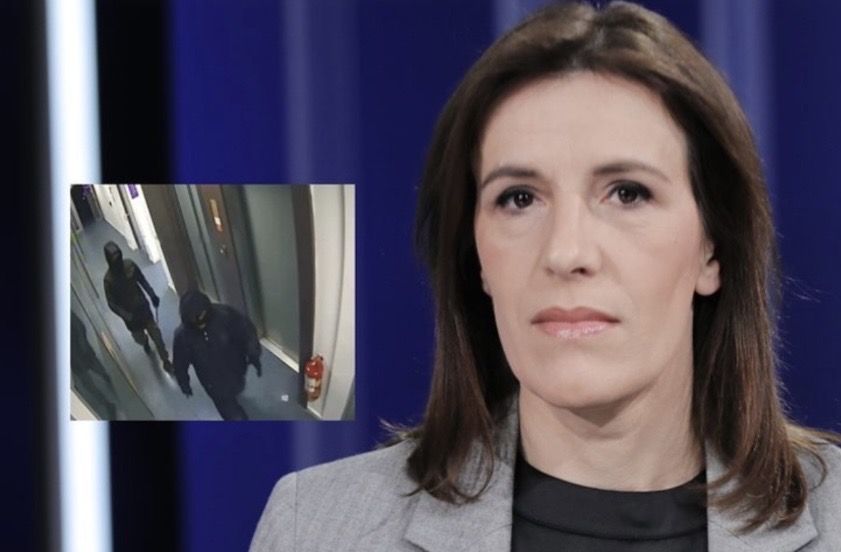
Lala stressed that the episode would not stop her reporting. “As a mother I was hurt; as a journalist I am not worried at all, because nobody can blackmail me in my work,” she said, referring to more than 23 years in journalism and recalling that her family had previously been exposed to gunfire. In 2018, her parents’ home was sprayed with bullets by an unidentified assailant; the perpetrators were not identified.
She said she would continue investigating Hyseni’s case, which she described as one of the most disturbing files she had covered during her professional career and one touching figures in politics, business and crime.
Lala also announced that she was preparing a criminal complaint to SPAK together with lawyer Dorian Matlija. More significantly, she interpreted Hyseni’s intervention as potentially carrying a message broader than the attack against one journalist: an attempt, in Lala’s view, to suggest that a former intelligence chief possessed secrets that could be used against those scrutinizing her.
Broad reaction from journalists’ organizations
The episode produced an unusually rapid and broad response from Albanian, regional and European journalists’ organizations.
The Association of Journalists of Albania, AGSH, condemned what it described as the “blackmail and attacks” against Lala “in the strongest terms.” It called on Hyseni to withdraw her statements immediately and urged SPAK to examine the incident seriously, saying that people facing judicial proceedings must answer before justice and that pressure or blackmail against journalists cannot be tolerated.
The Union of Albanian Journalists, UGSH, raised an even more sensitive issue. It described Hyseni’s declaration as “blackmail” and as a statement that raised the question of surveillance of journalists in Albania. The union demanded a transparent legal clarification of Hyseni’s allegation concerning alleged meetings with “Serbian spies” and warned that accusations of this kind could amount to an assault on the professional integrity of a journalist.
The Association of European Journalists, Albania branch, also condemned the incident in the strongest terms. It said it was unacceptable for a former senior state representative to answer journalists’ questions through personal attacks and insinuations capable of damaging professional integrity and potentially putting a reporter’s safety at risk. It emphasized that such statements acquire “extremely disturbing weight” when they come from someone who has headed the country’s intelligence service, and called on the competent institutions to respond.
The regional SafeJournalists Network went directly to the institutional implications of the episode. It expressed “serious concern” over the public intimidation and attempted discrediting of Lala and said Hyseni’s apparent claim to know whom the journalist had met and where raised questions about the possible use of privileged information obtained through state intelligence structures.
SafeJournalists called on SHISH, judicial institutions and the relevant oversight bodies to determine whether any information concerning Lala’s movements, communications or professional contacts had been obtained, accessed, disclosed or used in connection with the incident. It also asked the authorities to assess whether the accusation had increased risks to the journalist’s safety and to guarantee the confidentiality of her professional communications and sources.
The statement had a regional character, bringing together journalists’ associations from Albania, Kosovo, North Macedonia, Bosnia and Herzegovina, Croatia and Serbia.
News24, where Lala works, separately condemned Hyseni’s statement, stressing that no facts or evidence had been presented publicly to substantiate the allegation. The television station said journalists’ questions “are not blackmail” and cannot legitimately be answered with insinuations or personal accusations. If evidence exists, News24 said, it should be submitted to the competent institutions and tested according to law.
Opposition MPs react
The incident quickly entered political debate, with several opposition MPs describing Hyseni’s words as an attempt to intimidate the media.
Agron Shehaj, leader of the Mundësia party, expressed solidarity with Lala and called the episode “ugly and unacceptable.” He argued that the message was not directed only against one journalist but could be understood as a warning to other reporters examining sensitive allegations. Shehaj also called on Prime Minister Edi Rama to speak publicly in defence of the journalist and press freedom. These broader interpretations remain Shehaj’s political assessment of the incident.
Democratic Party deputy chairman Belind Këlliçi strongly condemned what he characterized as a threat against Lala and called on SPAK to examine whether another criminal offence, involving a threat against a media representative, should be investigated. Këlliçi also linked the episode politically to the Rama government; that part of his statement represents an opposition allegation rather than an established finding.
Gazment Bardhi, chairman of the Democratic Party parliamentary group, argued that Hyseni had avoided answering questions about the investigation by turning instead against the journalist. He described the confrontation as a personal attack rather than a substantive response to the allegations facing the former SHISH director.
Bardhi also identified what could become one of the crucial institutional questions in the case: if the information invoked by Hyseni was genuine and had been acquired through intelligence structures, how did such information come to be available for use outside its lawful institutional purpose? His wider accusations concerning the government and the management of SHISH remain political claims requiring independent evidence.
Berisha alleges journalists were under surveillance
Democratic Party leader Sali Berisha went further. He said he had previously alleged that SHISH had placed journalists under surveillance and argued that Thursday’s episode strengthened the need for those allegations to be investigated.
Berisha described Hyseni’s allegation against Lala as defamatory and retaliatory. He also argued that the potential use of intelligence information to exert pressure might not necessarily be limited to journalists, suggesting that prosecutors and judges could also be vulnerable. These are allegations made by the opposition leader and have not been established by the incident itself.
The distinction is important. Hyseni’s words do not themselves prove that Lala was placed under surveillance by SHISH, nor do they establish Berisha’s broader allegation that journalists have been systematically monitored or that the intelligence service has been used in domestic political struggles.
But they do create a question that is difficult to dismiss.
The legal dilemma: false information or intelligence information?
The potential legal implications are unusually sharp.
If Hyseni’s claim concerning Lala was false and knowingly communicated as a factual allegation capable of damaging her reputation, questions of defamation could arise. The fact that the allegation was phrased in the form of a question does not necessarily remove the factual implication conveyed that an investigative journalist had allegedly met foreign intelligence agents.
The question of intimidation must also be examined in context. Lala says the statement was intended to frighten her and other journalists investigating the case. Whether Hyseni’s conduct meets the elements of any criminal offence is a matter for prosecutors and, ultimately, a court. The language used by journalist organizations and politicians cannot substitute for a legal determination.
But the second possibility is potentially still more consequential.
If the information invoked by Hyseni actually existed and originated in SHISH files or intelligence operations, investigators would need to determine how it was obtained, whether the collection was lawful, whether it concerned legitimate national-security purposes, whether the material was classified or otherwise protected, who had access to it and whether it was disclosed or used outside the purposes for which it had been collected.
That could raise questions concerning unlawful disclosure of classified or protected information, privacy, the confidentiality of journalistic contacts and sources, and potentially misuse of state authority.
Legal expert and former prosecutor Eugen Beçi summarized the dilemma contained in the material surrounding the case in stark terms: if such intelligence existed but was never referred for an espionage investigation, questions arise about its handling and disclosure; if it did not exist, the issue becomes one of an allegedly fabricated accusation accompanied by the intimidating authority of a former intelligence chief.
This does not establish that SHISH illegally monitored Lala. Nor does it prove that Hyseni used classified intelligence on Thursday. Those facts would have to be established through an independent investigation.
Yet that uncertainty is precisely why the episode has resonated beyond an exchange outside the courthouse.
An intelligence service has powers unavailable to ordinary institutions. It may acquire highly sensitive information about individuals, contacts, movements and communications under strictly regulated circumstances. Those extraordinary powers exist to protect national security, not to supply personal leverage in disputes with journalists.
If no intelligence information existed, Hyseni must still account for the extraordinary public allegation made against a prominent investigative reporter. If such information did exist, the institutional questions become far larger: Why was an investigative journalist being monitored? Under whose authority? For what purpose? And how could information originating in the secret structures of the state become part of a public confrontation with the reporter investigating the former intelligence chief herself?
That is why the controversy is no longer merely about Vlora Hyseni and Klodiana Lala.
It has become a test of whether Albania can guarantee that journalists investigating organized crime, corruption and the possible links between criminal networks and public institutions can work without fearing that the intelligence capabilities of the state or even the suggestion of access to those capabilities may one day be turned against them.
Refine the analysis for publication
The post Former Intelligence Chief Accused of Blackmailing Leading Investigative Journalist appeared first on Tirana Times.